



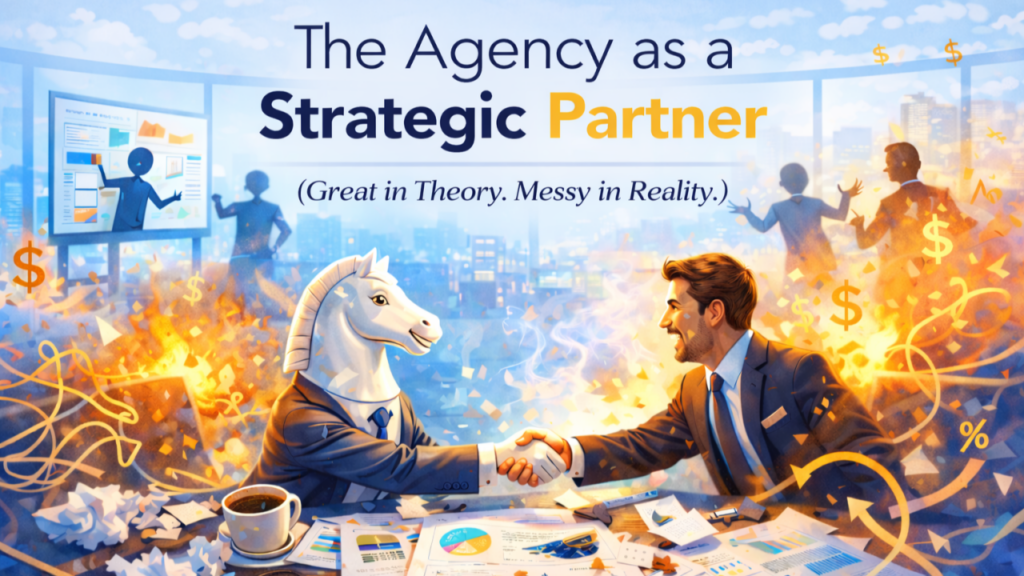
Most clients say they want strategic partners. In practice, agencies are often still vendors, just with nicer titles.
By now, almost everyone agrees that agencies should be more than execution vendors. We say it in decks. We write it on websites. We repeat it in kickoff meetings. Yet many agency relationships still work like this: “Here’s the brief. Here’s the timeline. Please don’t ask too many questions.”
So if the idea of agencies as strategic partners is already widely accepted, why does it still fail so often?
Because partnership is not a mindset issue. It is a decision-making issue.
Partnership Isn’t About Involvement. It’s About Permission.
Most clients say they want a strategic partner. What they often mean is: “We want better thinking, but only within the decisions we already made.”
Real partnership requires something more uncomfortable:
- Letting an external team question assumptions
- Allowing strategy to slow execution, at least initially
- Accepting that the first answer might be “this problem is framed incorrectly”
Without that permission, agencies remain vendors, regardless of how many strategy sessions are scheduled.

Strategy Dies When Agencies Are Brought in Too Late
A common pattern still shows up everywhere: A campaign is already decided. Budgets are roughly allocated. Internal alignment is assumed.
Then the agency is asked to “add strategy”. At that point, strategy becomes decoration, not direction.
Strategic value only exists when agencies are involved early enough to help shape the problem, not just polish the output. Otherwise, even good thinking is reduced to refining decisions that were never properly examined.
Data Didn’t Kill Creativity. Fear Did.
Data is often blamed for making work conservative. In reality, data has simply removed excuses.
Clients now expect agencies to justify decisions, measure impact, and adapt quickly. That is fair. What is less fair is expecting certainty in environments that are inherently uncertain.
Strong partnerships use data as a navigation tool, not a safety blanket. Data informs judgement. It does not replace it. When agencies are trusted to interpret, not just report, the work becomes both smarter and braver.

Not Every Client–Agency Relationship Should Be a Partnership
This is the part rarely said out loud.
Strategic partnership is not right for every client, every project, or every moment. Some situations genuinely require fast execution, narrow scope, and minimal debate. That is not failure. It is clarity.
Problems arise when clients want partnership benefits while maintaining vendor controls. That tension produces frustration on both sides and predictable results for everyone.
Good partnerships are chosen deliberately. They are not default settings.
The Agencies That Will Matter Going Forward
The agencies that thrive will not be the loudest or the most “full-service”. They will be the ones that:
- Know when to push back, and when to execute
- Understand the business well enough to disagree intelligently
- Are judged by the quality of decisions they help shape, not just outputs
That is not a romantic version of partnership. It is a demanding one. Agencies do not become strategic partners by declaration. They become strategic partners when their thinking is allowed to influence decisions, not just outputs.
Until then, the title changes. The role does not.
www.pamplusplus.com An Adaptive, End-to-End Branding and Marketing Consulting Firm. with NO SLOGAN. JUST RESULTS