




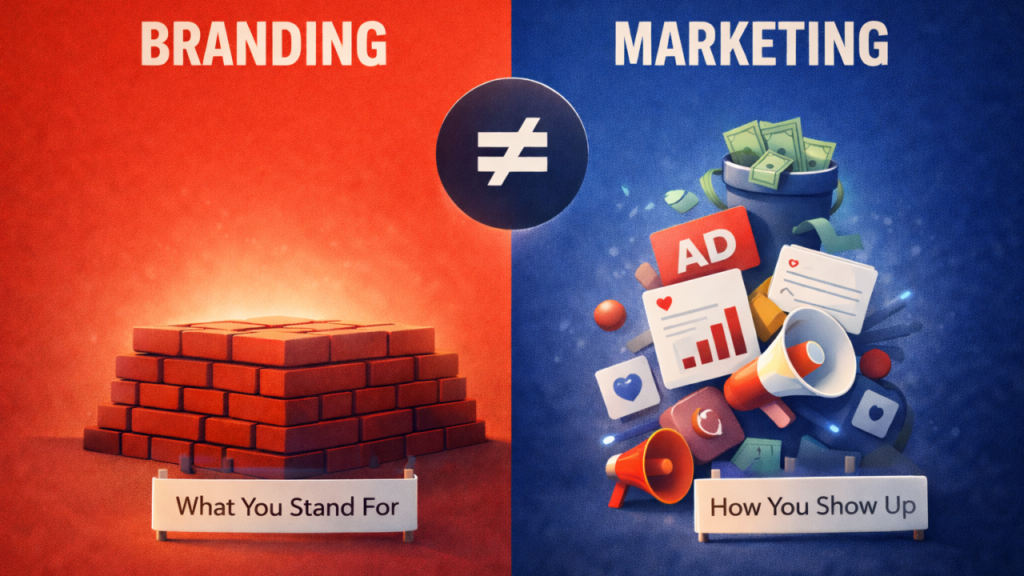
These things I’m about to write about should be obvious, right? After all, branding is the heart of any business, and it impacts every decision, every interaction, and every strategy.
And yet, in practice, it rarely works that way.
For many companies, branding is still seen as just a marketing function, relegated to the creative team or the advertising budget. Too many businesses overlook the fact that branding isn’t a side project; it’s a strategic driver that impacts everything from culture to customer loyalty to pricing power.
Marketing tactics may offer quick wins, but true brand strategy requires a long-term vision. And long-term thinking is usually where most organizations start to get uncomfortable.
🎧 Listen to the podcast
If branding is not just marketing, where does it actually show up?
Branding is not just about slogans, logos, or campaigns. Those are the outputs. What matters is what sits behind them.
At its core, branding should influence how decisions are made across the business. From what you build to how you deliver, every choice is shaped by it. Or at least, it should be.
A strong brand doesn’t just build awareness. It creates value. And that value shows up across the business, from culture, to product, to pricing, to customer loyalty, and ultimately, how you compete in the market.
Branding Shapes Your Company’s Vision and Culture

When you think about branding as a business strategy, the first place to look is your internal culture. Your brand isn’t just something that exists outside your business, it starts within it. Every interaction, decision, and communication needs to align with the values and mission that make your brand what it is. Otherwise, the brand stays in slides, not in behavior.
A clear brand creates alignment. People understand what the company stands for and how they contribute to it. Without that clarity, teams default to speed, convenience, and short-term decisions.
Brand Strategy Influences Product Development

If you think branding ends with your logo or your advertising, you’re missing the point. Branding should influence what you build.
In reality, product decisions are already brand decisions, whether you label them that way or not. Your brand tells you who your customer is, what they care about, and what is actually worth building. It also helps you decide what not to build. Without that, product becomes guesswork. With it, product becomes direction.
Brand Positioning Determines Pricing Power
Let’s talk about pricing. A strong brand can support premium pricing, but not just because it looks better. Because it’s clear. Clear in who it’s for, what it delivers, and why it matters. When that clarity is missing, price becomes a negotiation. When it’s strong, price becomes a decision.
Clarity reduces friction. Confusion creates discounting.
Branding Drives Customer Loyalty and Retention

Branding’s role in customer loyalty can’t be overstated. In a world where consumers have endless choices, branding is the force that makes people stick around, but not because of messaging alone. A strong brand creates consistency customers can rely on. When your brand is strong, customers don’t need constant reminders. They already know what to expect.
And when that experience breaks, no campaign can fix it fast enough.
Branding Creates Competitive Advantage
Lastly, branding is one of the most effective ways to create a competitive advantage. In saturated markets, where products and services often look alike, it’s your brand that helps you stand out, not because it’s louder, but because it’s clearer.
A strong brand communicates your unique value proposition and makes it easy for customers to understand why they should choose you, and it does so consistently, not occasionally.
Branding is the Heartbeat of Your Business Strategy

In the end, branding isn’t something you slap on at the end of a business plan or bolt on to a marketing strategy. It only works when it’s built into how decisions are made from the start.
From product development to customer service, from pricing to positioning, branding is the thread that connects everything. Without it, businesses still operate, just not coherently.
So, if you’re still treating branding as marketing, you’re already limiting what it can do.
Not as a function. Not as a deliverable. But as a way of running the business.
www.pamplusplus.comAn Adaptive, End-to-End Branding and Marketing Consulting Firm.
NO SLOGAN. JUST RESULTS